
no image
Episode 1
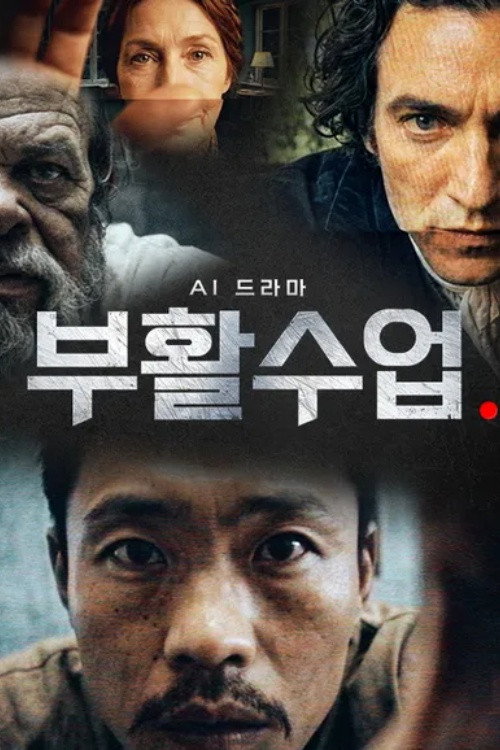
In his solitary cell at Lüshun Prison, Ahn Jung-geun turned on the camera. On March 24, 1910, he left a "video letter" in his cell at Lüshun Prison, recorded with the camera running.
machine translated


Log in or create an account to rate titles and keep a watchlist.
We don't know of any offer in this country. That doesn't mean there isn't one — just that our sources don't report any.
These offers belong to each country's catalog and usually can't be watched from here.
Availability data partly provided by JustWatch via TMDB.
Page 1 of 1 · Episodes 1–14
In his solitary cell at Lüshun Prison, Ahn Jung-geun turned on the camera. On March 24, 1910, he left a "video letter" in his cell at Lüshun Prison, recorded with the camera running.
machine translated
In 399 BC, Socrates, facing the death penalty, refuses an offer to escape his cell and accepts his death as he looks back on his trial. Socrates emphasizes that he chose the death penalty to defend his awareness of his own ignorance and his philosophical beliefs.
machine translated
On December 3, 1940, Yun Dongju turns on the camera and documents his inner feelings. On a night when he can't write poetry, he asks himself questions and confronts the shame and conscience of his time. This video recording contains a poet's confessions and reflects the inner world of a person of …
machine translated
On the night "A Room of One's Own" was published in 1929, Virginia Woolf discusses her work and ideas and speaks about the conditions women face when writing. She highlights the social and economic barriers women face and conveys the message that intellectual freedom is possible on a material …
machine translated
In the final moments, as the age of the gods ends and the age of humanity begins, Prometheus confesses why he chose to bring fire to humanity. As a creator, he feels compassion and responsibility for humans and defies the order of the gods, even though he knows he will be sentenced to eternal …
machine translated
In November 1854, Florence Nightingale arrives at a hospital in the middle of a war. Infection and neglect claim more lives than rifles do. She discovers the causes of death through statistics and records and begins transforming hospitals. These records represent more than a nurse's struggle; they …
machine translated
On October 11, 1802, Ludwig van Beethoven writes his will and finds reasons to keep living in his room the next day. Amid despair over his fading hearing, he resolves not to give up his destiny as a musician. Through an artist's suffering and choices, this account shows how people can live in the face of their fate.
machine translated
On the morning of his 1952 trial, Alan Turing recounts his life and research and asks whether machines can think. He questions the criteria used to distinguish human thought from machine thought and argues that intelligence can be shown through behavior and responses. At the same time, he refuses …
machine translated
On Christmas Eve 1882, after Lou Salomé leaves him, Nietzsche declares "Amor Fati," the acceptance of one's fate, despite the despair of betrayal. He defines a new kind of love based more on action than feeling and transforms his anguish into artistic energy. This merciless loneliness will …
machine translated
At 7 a.m. on April 29, 1932, after Yun Bonggil was sentenced to death, Baekbeom Kim Gu left a sorrowful but resolute statement, hoping the mission would succeed. He had to make the painful decision to send young people to their deaths despite the provisional government's defeat and their hardships …
machine translated
In late autumn of 312 BC, Mencius spends his third night at a guest station on the border before leaving the state of Qi, unable to give up his last hope. He preached to the King of Qi that human nature—shame and compassion for the suffering of others—is essential to being a king, but the king …
machine translated
Prince Siddhartha, having witnessed birth, aging, illness, and death, as well as the cruel suffering of living beings, develops profound doubts about the injustice of the world. He rejects his father King Suddhodana's offer to keep him from renouncing the world and give him anything he desires …
machine translated
Amid the Japanese invasion and her husband's death, Nam Hyun lost her will to live. The March 1st Independence Movement brought her back to life, and she threw herself into the independence movement. As an exile in Manchuria, she founded a women's education group and supported the independence …
machine translated
In September 1592, a former slave named “Sangja,” who serves as a sailor aboard a panokseon ship in the left division of the Jeolla Navy, tells the story of his life on the night before the Battle of Hansan Island. Sangja testifies that it was possible to wage war because nameless people sat …
machine translated
Images © their respective rights holders · Source: TMDB